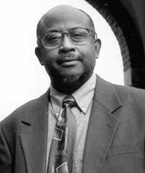
Haitian History as Antidote to Eurocentrism

I have to remember to tell my mother how much she influenced me as a historian. Mary Ellen Tamari lived in and studied a rural community, Bellevue la Montagne, in the mountains above Port-au-Prince, Haiti for the better part of a decade. One of the many insights she shared with me before I had any inkling of its importance is how Haiti embodies so much of the world. Among its fewer than ten million people and in a space that is six times smaller than that of Illinois, it manages to be thoroughly African and, at the same time, European and Caribbean to the core.

Haitian scholar Michel-Rolph Trouillot (1942-2012) published his first book in 1977, Ti dife boule sou Istwa Ayiti, a history of the Haitian revolution reputed to be the first book-length monograph ever published in Haitian Creole.

Last year, the social sciences lost a powerful intellect and writer in the Haitian anthropologist Michel-Rolph Trouillot whose Silencing the Past: Power and Production of History (1995) amplifies my mother’s point many times over. He offers a critique of West-centric modern history that is one part theoretical, even philosophical (he proposes a “theory of the historical narrative”) and one part super empirical and grounded in the details of the Haitian Revolution, a field in which he has few peers. (Nod to Wikipedia: I just discovered that his first book, a history of the Haitian revolution, was the first book-length monograph published in Haitian Creole.)

By “silencing the past”, Trouillot wants to point to a reality that may not be obvious to the lay person. History is not, as some might imagine and as we are usually led to believe in grade school, “the past”. History is what a society collectively remembers about the past. It is, to some extent, a purely human creation. One popular reflection of this truth is the commonplace “history is written by the victors.” This does not mean, Trouillot cautions, that history is fiction, as some postmodernists might have it. The past is retrieved selectively to serve certain purposes and certain interests.

As a way of reaching his American audience, he begins with the story of the Alamo. There are at least three completely different versions of this story and it is no coincidence that the one staring Davy Crockett is best known to most Americans. “Remember the Alamo!” was a call to arms issued by a grossly outnumbered crew of freedom-loving patriots who were willing to fight to the death. Now it is Texas’ main tourist attraction where sales of coonskin caps fortify what is probably a myth. There are other, completely legitimate, versions of what happened that have totally different implications. The souvenir shops may be located on a native American burial site. If that’s the case, perhaps the story is really one of violent US westward expansion. Or did the defeat of the Anglos at the mission actually serve as a pretext for annexation of the territory from Mexico? Trouillot points out that as Texas’ Mexican-American population grows (it more than a third now), Davy Crockett may be unseated.

What matters, says Trouillot, is not what actually happened but what is remembered and… what is silenced. (One consequence of this observation for historians is that professional scholars have little impact on the outcome. What gets remembered (or forgotten) has to do with forces far beyond the academy).

To illustrate the power of silence, Trouillot offers two compelling examples from Haitian history.

The first is offered as a criticism of Haitian nationalist versions of the Haitian revolution. According to this version, Louverture and his band of rebels launched the first successful slave revolt and defeated the mightiest army on earth to create the first black republic in history.

Actually, demonstrates Trouillot, Louverture and the other revolutionaries, including Jean-Jacques Dessalines and Henri Christophe, actually tried to squelch the slave revolt after they were initially defeated by the French.

Sans-Souci_Palace_front

Sans Souci (Milot) Palace: built on the grave of Congolese slave rebel Jean-Baptiste Sans Souci?

Troulliot unravels this singular case of a lost history with such care and precision this chapter alone is worth the price of the book. It all hinges on the name “Sans Souci” which has three “faces”. Sans Souci is best known to Europeans as the name of Frederick the Great’s palace in Potsdam near Berlin. To Haitians, Sans Souci is the name given to King Henry (Christophe) I ’s palace in Milot near Cape Haitian, the capital of northern Haiti. It lies in ruins in the shadows of Henry’s famous fortress, the Citadel.  Finally, Jean-Baptiste Sans Souci was an ex-slave who refused to compromise with the French and kept on fighting until he was killed by forces loyal to Henri Christophe.

Here’s the chronology: the Haitian revolution started in 1791. A French expeditionary force quelled the revolt between 1802-1803 and managed to enlist former revolutionaries, like Louverture, Christophe, and Dessalines. (The French officially abolished slavery in 1794 so there was a carrot added to the stick.) But, unlike these Creole leaders (who were born into slavery), slaves born in West Africa like Jean-Baptiste Sans Souci never surrendered and were only subdued at the hands of former revolutionaries like Christophe who had Sans Souci ambushed and killed. Once a lieutenant of Christophe’s, Sans Souci refused to continue serving one whose allegiance to the cause of freedom was suspect.

The significance of the story hinges on why Christophe, once he became one of independent Haiti’s first rulers, named his palace “Sans Souci”. Most historians, Western and Haitian, assume it was in tribute to the Prussian king whom he emulated. Trouillot argues, however, that the evidence suggests Christophe built it a few yards from where he had Jean-Baptiste killed as a transformative ritual (with West African roots) to absorb all that his rival represented.

Henri Christophe effectively erased Jean-Baptiste Sans Souci from history twice. Once by killing him and once by naming his palace after him. Haitians (politicians, journalists, and historians alike) have prefered to leave him silenced as his story illustrates the uncomfortable reality of revolutionaries who were not as revolutionary as they would like to believe.

Though Trouillot’s telling of this story is more finely wrought, his chapter on the world historical significance of the Haitian revolution will give pause to anyone who thinks they know modern history.

The events of the Haitian revolution made real the principle that racial or ethnic or geographical categories were irrelevant to who could govern. Any group can rule itself. The deeds of the Haitian revolutionaries also embodied for the first time in history the right of all peoples to self determination. Did you get that? The first time. Ever.

These principles were not part of the American Revolution, the French Revolution or even widely held until the middle of the 20th century. More, the idea that anyone but Europeans were able to rule themselves was unthinkable to Europeans before the revolution, during the revolution, and more than 100 years afterwards. Europeans had no conceptual framework for this kind of eventuality. So, it was not simply forgotten, it was a non-event. It did not fit. IT could not be accomodated to the patterns of thought shared by European intellectuals and elites… since and up to the present.

The significance of the Haitian revolution remains unacknowledged. Western historians have basically retooled 18th- and early 19th-century ”formulas of erasure” to ignore its power. The fate of Haiti since (as a pariah state, as an economic and political basket case) invalidates  the revolution’s accomplishments; blacks were not up to the task.  Or, the revolution was really inspired by external influences. In 1996 Eric Hobsbawm, English Marxist historian extraordinaire, published The Age of  Revolution, 1789-1848, which many consider a classic. It scarcely mentions Haiti. It is still in print and widely used as a textbook. Western historians of Haiti have done little better. In the hands of specialists, the Haitian revolution has suffered what you might call “death by historiography”. Working in their empirical fields of expertise they have uncovered masses of data and have yet to see the forest for all the trees. Or, it is still “unthinkable” to the Western mind.

Trouillot ends this chapter on this very point:

“The silencing of the Haitian Revolution is only a chapter within a narrative of global domination. It is part of the history of the West and it is likely to persist, even in attenuated forms, as long as the history of the West is not retold in ways that bring forward the perspective of the world.” (107)

 NotebookHow could I resist this meme? I wonder if Michel-Rolph Trouillot ever considered that he might be remembered in this way. Jean-Baptiste Sans Souci and the Haitian revolution may have been silenced but not Trouillot himself.

Posted in Uncategorized, World History | Tagged , , , , , , , | Leave a comment

Witch Hunts and World History: A Feminist History of Capitalism

Thus far in our exploration of Eurocentrism (and its crtics) in the writing of modern world history, my graduate students and I have not seen radical challenges to keeping Europe at the center. For all their efforts to redress the balance in favor of the non-West, critics of Eurocentrism– not surprisingly– remain constrained by the very Eurocentrism then want to challenge.

Here is the first of two overviews of scholarly interventions which approach modern history “laterally” and strive to avoid reproducing the very fundamentals that under gird a Eurocentric outlook. The first comes from a feminist working in the Marxist tradition.

Manchester, UK-based cartoonist P.J. Polyp's "Gold Diggers" illustrates the concept of primitive accumulation nicely.

Manchester, UK-based cartoonist P.J. Polyp’s “Gold Diggers” illustrates the concept of primitive accumulation nicely.

In Caliban and the Witch: Women, the Body, and Primitive Accumulation (2004), Silvia Federici reaches back farther than we have ventured so far to locate the advent of the capitalist relations of production. As a Marxist, Federici believes that understanding capitalism is the only way to comprehend the nature of exploitation in our world. She rejects, however, the Marxist view that capitalism in Europe represented progress in the direction of freedom and equality over what preceded it. She also holds that “primitive accumulation”, Marxese for naked conquest, pillaging, and robbery, remains at the heart of capitalism. (Forcing peasants off their lands through land enclosures and robbing the Americas of their gold and silver are examples.) This goes counter to the view among many Marxists that primitive accumulation predated capitalism and explains how some people started out with enough wealth to create more wealth, ie. capital itself.

Yes, fine, but what about history and women? Between the 9th and 11th centuries, western European serfs had made significant gains against their overlords such that they were on the verge of creating a more egalitarian political and economic system than what preceded it and what was to follow. They had successfully resisted forced labor commitments (corvée) and military duties and, in many areas, had unfettered access to land. Dissident Christian movements of the late medieval period–notably the Cathars and the Waldensians, in Federici’s words, “liberation theology for the medieval proletariat” (33)– combined with urban protests and peasant uprisings to signal unprecedented gains on the part of the masses of medieval Europe. “What this meant for the European proletariat was not only the achievement of a standard of living that remained unparalleled until the 19th century, but the demise of serfdom. By the end of the 14th century, land bondage had practically disappeared. Everywhere serfs were replaced by free farmers– copy holders or lease holders– who would accept work only for a substantial reward.” (47)

So, you ask, what went wrong? Federici’s argument about the transition to capitalism hinges on two transformations: 1) the monetization of peasant duties– whereby peasants could pay cash in lieu of labor duties or payments in kind — created a new class antagonism that would ultimately undermine previous gains; and 2) the ability of states and municipalities to co-opt males by decriminalizing rape and promoting prostitution  ”turning class antagonisms into antagonisms against proletarian women.” (47) Between 1350 and 1450, publicly managed, tax financed brothels opened in every town and village in Italy and France creating what Federici dubs a “Sexual New Deal”.

Caliban (Todd Scofield) in Folger Theatre's production of Shakespeare's The Tempest in 2007. A rebel slave born of a witch, Caliban (anagram for "cannibal"?), personified the fears of Europe's capitalist elite in the transition from feudalism to capitalism.

Caliban (Todd Scofield) in Folger Theatre’s production of Shakespeare’s The Tempest in 2007. A rebel slave born of a witch, Caliban (anagram for “cannibal”?), personified the fears of Europe’s capitalist elite in the transition from feudalism to capitalism.

The degradation of working women coincided with the creation of an alliance between richer peasants, urban elites, the nobility, and the Church which turned the economic crisis of the late medieval period into what became the world capitalist system. The three prongs of this effort were witch hunts in Europe and the enslavement of native Americans and then Africans.

Before turning to the witch hunts, Federici, demonstrates how the Scientific Revolution and the Enlightenment created the ideology of the body-as-machine and strove to dispel all notions, such as magic, that are predicated on the unity of matter and spirit. Capitalist rationality was needed to eradicate all beliefs that might suggest one could obtain what one wanted without work.  Prophesy and fortune telling needed to be replaced with the calculation of probabilities. In sum, “The human  body and not the steam engine, and not even the clock, was the first machine developed by capitalism.” (146).

The witch, here depicted by German artist Hans Weiditz (d. 1537) embodied magic, herbal remedies (including birth control), and other qualities that threatened a capitalist order.

The witch, here depicted by German artist Hans Weiditz (d. 1537) embodied magic, herbal remedies (including birth control), and other qualities that threatened a capitalist order.

Woman’s body was the primary site for eradicating resistance to capitalism and to a rationalist ordering of the world. Witch hunts reached their peak between 1580-1630 when hundreds of thousands of women were tried, tortured, and burned. This period corresponds to a time when male political elites were concerned with population decline. In addition to offering correctives to some of her Marxist colleagues, Federici also strives to reclaim feminism from those who would discount “woman” as category of analysis. Since reproduction is central to woman’s place in the capitalist order, social and cultural factors are not sufficient for understanding capitalism’s assault on women’s bodies. Furthermore, witch hunts also uncover the central role of new state structures in engineering the success of capitalist relations of production (and reproduction). Though some of their methods may have derived from the Inquisition, the witch hunts were administered by states and secular courts and not by the Church. “Witch hunting in Europe was an attack on women’s resistance to the spread of capitalist relations and the power that women had gained by virtue of their sexuality, their control over reproduction, and their ability to heal.” (170)

Here are two ways in which Federici offers alternatives to Eurocentric narratives of modern world history. On the one hand she argues for as deep a fissure as one could possible conceive of (that between the sexes) in Europe itself. You can’t have a center if it is completely divided against itself. On the other, her critique of capitalism (and of its Marxist critics) is fundamentally a critique of modernity itself insofar as capitalist exploitation and Enlightenment rationalism triumphed at the expense of medieval communalism and an enchanted view of the world.

Posted in History and Historians, World History | Tagged , , , , , , , , , , | 2 Comments

Competing Approaches to Modern World History, Part II: The Case of Europe’s Late Take-off

Les_Très_Riches_Heures_du_duc_de_Berry_mars

The illustration from March from the early 15th-century book of hours, Les Très Riches Heures du duc de Barry. Books of hours contained liturgical texts for appropriate prayers to accompany the Christian calendar. In contrast to the days when European historians saw medieval Europe as foreign to modern European history (as they did non-European history), in the last generation or so, economic historians of Europe have argued that the wealth that made the “age of exploration” possible had accumulated over the previous 500 years. In addition to other purposes, this buttresses the claim that modern Europe’s expansion owed more to internal developments than to the pillaging of the Americas or the sweat and blood of slaves.

This week my graduate students and I explored a new front in the battle over modern world history. To recap the first installment in this series: David Landes argues for the cultural factors that explain European economic success in the modern period. This is not all that surprising since scholars like Max Weber have been making such claims for the better part of the last 100 years. What I am realizing now, however, is that starting with the publication of Eric Jone’s influential The European Miracle: Environments, Economies, and Geopolitics in the History of Europe and Asia (1981), European historians have adjusted the claim that European countries burst forth as economic powerhouses around 1500 (as was the standard explanation a generation ago). Instead, historians like Jones and, following him, Landes, argue that European economic success was predicated on the slow accumulation of wealth, expertise, and capitalist-friendly laws and institutions over the previous 500 years or so. Expansion in the Americas and the industrial revolution was fueled by a half century of economic, social, and cultural developments.

This week we read and discussed Kenneth Pomeranz, The Great Divergence: China, Europe, and the Making of the Modern World Economy (2000). Pomeranz offers a powerful corrective to the version of European history outlined above through close empirical attention to Europe, China, and Japan during the period from 1600 to 1800.

His most important conclusion is that in terms of all the factors that count (so to speak) economically (population, family size, wealth, access to and exploitation of land, reliability of markets, ability of labor to move), Europe (particularly western Europe) and China and Japan were on the same footing as late as 1800. Europe was developing no advantages (over these regions) in 1000, nor in 1500, no, not until 1800. That’s late! All our world history textbooks and most world history surveys come in two parts, before 1500 and after 1500.

Pomeranz cover

Cover of Ken Pomeranz’s The Great Divergence.

I find his evidence compelling. This is a quick overview.

In terms of population growth, there is an argument that says that a European fertility pattern (late age of marriage, tradition of celibacy among clergy) kept populations low and therefore reduced pressure on the land allowing for more productivity. In fact, families in China and Japan were relatively small, too. Life expectancy was also similar across these regions.

In terms of wealth, there is no evidence that Europeans were wealthier or more productive than their Asian counterparts during this period.

In terms of science and technology, ditto. The “scientific culture” attributed to Europe was not unique to Europeans. The Chinese dominated irrigation technology, for example. Europeans were behind in land conservation.

Downton_publicityPortrait

The misfortunes of Downton Abbey’s Earl of Grantham have introduced today’s audiences to the persistence of non-market factors in the distribution and transfer of land in Britain even into the 20th century.

How about market economies? Landes repeats the claim (over and over) that Chinese producers were subject to the ills of “oriental despotism” which smothered any drive by entrepreneurs, merchants, artisans, or peasants to be inventive, creative and more productive. There was  no room for private property and, therefore, private initiative. To the contrary, argues Pomerantz. In China, the overwhelming majority of land was freely alienable. Not so in Europe where hereditary estates often stifled the consolidation of land holdings. (Consider, for example, the fictional Crawleys of Downton Abbey who are struggling with the problem of how to keep land in the family as late at the early 20th century; it’s not all fiction. Read this interesting piece on “entails” and the Crawleys).

How about the idea that a new ethos, the much heralded “Protestant” or “work” ethic– which is supposed to be so singularly northern European–sparked rationalized economic behavior in early modern Europe? Pomeranz argues that, to the contrary, what drove consumption and thus production in Europe was demand for luxury goods and what he terms “everyday luxuries” like sugar, tobacco, and tea which became more and more important to the up and coming classes. Even here, however, Europe is not special. The Chinese had cultivated a sweet tooth earlier and produced their own sugar and, of course, tea.

In just about every category in which historians of Europe have postulated a European advantage at least as early as 1500, China and Japan were not behind and, in many cases ahead, of their western counterparts. Labor and land markets in China, in particular,  conform more to the neoclassical ideal of free trade than was the case in Europe.

manure

Who would have known you could calculate kilograms of manure to acre of cropped land for the 18th century to support claims about releasing population pressure on the land, the greatest ecological challenge faced by pre-industrial economies in Europe and Asia?

[Lest you think these dramatic conclusions are based on conjecture, Pomeranz marshals all manner of empirical evidence. The book concludes with appendices under titles like "Estimates of Manure Applied to North China and European Farms in the Late Eighteenth Century, and a Comparison of Resulting Nitrogen Fluxes," "Forest Cover and Fuel-Supply Estimates for France, Lingnan, and a Portion of North China, 1700-1850" and "Estimates of Earning Power of Rural Textile Workers in the Lower Yangzi Region of China, 1750-1840."]

The lynchpin in Pomeranz’s argument is what happened after 1800. He does not dispute the fact that by 1800, Europeans were moving ahead in all the factors of production, access to markets, technological innovation, and the accumulation of wealth.

Conquest of the Americas provided Europeans with the perfect periphery for raw materials and markets for their manufactured goods that the Chinese and Japanese could not match. It’s not that slave labor generated enough wealth to give Europeans the edge. No, it was that new sources of land and resources as well as markets that created the perfect solution to western Europe’s diminishing access to land and raw materials and a new captive (so to speak) market for its manufactured goods.

The benefits accrued to Europe from the exploitation of the Americas (and of its native peoples) as well as of African slaves (non-market and non-European factors of production) made “transatlantic trade  a uniquely self-expanding route by which Europe (especially Britain) could use its labor and capital to relieve its hard-pressed land and thus turn even a demographic and proto-industrial expansion that (unlike in east Asia) far outpaced advances in agriculture into an asset for further development.” (296)

Not only was Europe not ahead of the pack until very late, but the circumstances that made for its success were primarily non-economic forces and clear violations of theories of free market capitalism (as touted by free-marketeers such as Landes) like unfree (slave)  labor.

I was bowled over. And a few of my students were likewise very impressed. My only Chinese student who said she had been brought up on the same theories of a European   “miracle” that are so widespread in the West and was inspired by Pomeranz’s work. Others, however, remained unmoved. They had two main criticisms: 1) so what if Europe zooms ahead in 1800 rather than 1500? the result is the same; and 2) the new American periphery may have not yielded the results that gave Europe the decisive edge until 1800, but since most of these territories had fallen under European control as early as the 16th century, isn’t it true that the die had been cast earlier?

The debate continues.

Posted in East and West, History and Historians, World History | Tagged , , , , , , , , | Leave a comment

Try Some Radical for a Change

JacobinImage

This image of the leader of the Haitian Revolution, Toussaint L’Ouverture, is the journal’s logo. In the words of managing editor Connor Kilpatrick, “Because as much as the idea of Jacobinism is associated with a single nation, the Haitian Revolution is the story of how an ideology that sprang up in a country thousands of miles across the ocean could make it’s way over and inspire the most oppressed to rise up and accomplish the impossible.”

What a welcome surprise to find that young writers are thinking and writing about radical change, and are even–dare I say– agitating for socialism. I just discovered a new journal that demonstrates (once again) the poverty of Liberalism in its many guises. At the same time, it strives to rescue Marxism from ideological and jargon-induced irrelevance. Jacobin is the brainchild (when am I going to have one of those?) of Bhaskar Sunkara who just got a nice write-up in the New York Times. 

I checked out their back issues and discovered this gem: “Burn the Constitution”. Seth Ackerman lays bare the ugly (and simple) reality behind what we are so often told is the marvel of human political thought, the American Constitution. In actuality, the Constitution enshrines a system created by a band of landowning white men to guard against “mob rule”.

[They] rendered it virtually impossible for the electorate to obtain a concerted change in national policy by a collective act of political will. The Senate is an undemocratic monstrosity in which 84 percent of the population can be outvoted by the 16 percent living in the smallest states. The passage of legislation requires the simultaneous assent of three separate entities — the presidency, House, and Senate — that voters are purposely denied the opportunity to choose at one time, with two-thirds of the Senate membership left in place after each election.

Not to mention the Amendment process:

[The] entire system is frozen in amber by an amendment process of almost comical complexity. Whereas France can change its constitution anytime with a three-fifths vote of its Congress and Britain could recently mandate a referendum on instant runoff voting by a simple parliamentary majority, an amendment to the U.S. Constitution requires the consent of no less than thirty-nine different legislatures comprising roughly seventy-eight separately elected chambers.

Yes, we should all have remembered this, but what makes Jacobin‘s brand of up-to-date radicalism so compelling is the kind of analysis Ackerman offers next concerning what has happened to thinking about the Constitution more recently. After WW I, when the desire for radical change inspired Europeans to curtail the privileges of elites, American progressives began to challenge the rigidity of the political system here. That, in turn, inspired a backlash which has solidified resistance to change. Presently, we are consumed by Tea Party-inspired Constitution fetishism and what have Liberals done to combat it? In defending the Constitution against Right-wing interpretations, Liberals take it as an article of faith that the document is actually a living document whose meaning is open to constant negotiation. Hogwash, concludes Akerman, the Constitution is little more than a “charter for plutocracy”.

Ackerman’s article (not the Constitution) should be required reading on Sept. 17, Constitution Day, which itself is a Senate invention of very recent vintage (2004). By law,  Constitution Day must be recognized by all schools receiving federal funds. Next time SIUE (or any other public university) holds this remembrance it may be worth noting that this is not an outpouring of civic pride but a government mandate.

There is much more to recommend Jacobin as well. Find out for yourself.

Posted in Uncategorized | Tagged , , | Leave a comment

Competing Approaches to World History: Part 1, NeoEurocentrism

McArthur's Universal Corrective Map of the World

McArthur’s Universal Corrective Map of the World was the first mass produced map to offer an “upside down” view of the world. Despite their ubiquity, conventional maps with a northern orientation are not more accurate. Stuart McArthur from Australia (“down under”) did not like always being positioned at the bottom. Others feel the same way. There is an interesting story behind McArthur’s project. He drew his first South-Up map when he was 12 years old (1970). His geography teacher told him to re-do his assignment with the “correct” way up if he wanted to pass. Three years later he was an exchange student in Japan. He was taunted by his exchange student-friends from the USA for coming from “the bottom of the world.” It was then, at age 15, he resolved to one day publish a map with Australia at the top. Six years later, while at Melbourne University, he produced the world’s first “modern” south up map and launched it on Australia day in 1979. It has sold over 350,000 copies to date.

During the last 20 years or so in American education, courses in World History have replaced courses in Western Civilization as compulsory for most undergraduates. The Illinois State Board of Education, for example, now requires students who want to be certified in Illinois public schools to have at least two semesters of a World History, rather than a Western Civilization survey. This change is the result of a host of factors including decolonization in the post-World War II era; the civil rights movements of the 1960s and 1970s; and the rise of Ethnic and Women’s Studies and of Social History and Environmental History in the more recent past.

There remains, however, much debate about how World History should be conceptualized. Should the organizing principles (or explanations) be cultural, environmental, economic, social, or political? Even more contention surrounds the relative weight given European powers and economic forces during a period in which some European states were able to exert unprecedented control over the globe. As one might imagine these debates are not entirely “academic”. They resonate with the “culture wars” and the debate over multiculturalism that are themselves the result of profound demographic and political changes affecting the American social fabric.

I am in the process of teaching a graduate course on this subject. I have come up with a reading list that spans the spectrum from the unabashedly Eurocentric (David Landes, The  Wealth and Poverty of Nations: Why Some are So Rich and Some So Poor (1999)) to largely empirical challenges to Eurocentrism in world history (Kenneth Pomerantz, The Great Divergence: China, Europe, and the Making of the Modern World Economy (2011)) through the efforts by post-colonial writers to recenter history-writing (Michel-Rolph Trouillot, Silencing the Past: Power and the Production of History (1995) who I just discovered passed away last summer) to more radical feminist and Marxist critiques (Silvia Federici, Caliban and the Witch: Women, the Body and Primitive Accumulation (2004) and Peter Gran, The Rise of the Rich: A New View or Modern World History (2009)). There are others in between.

Where to start?

The-Wealth-and-Poverty-of-Nations-9780393318883

Does David Landes’ 1999 work The Wealth and Poverty of Nations represent something new or a rehashing of old Eurocentric theories about economic history? Certainly the wide acclaim it has received suggests it touches a nerve regardless of the vintage of the ideas therein.

The first book the students are reading is the one by David Landes. The book opens boldly: “My aim in writing this book is to do world history. Not, however, in the multicultural, anthropological sense of intrinsic parity: all peoples are equal and the historian tries to attend to them all. Rather, I thought to trace and understand the main stream of economic advance and modernization; how have we come to where and what we are, in the sense making, getting, and spending.” (xi) The author’s revulsion for the changes in the academy over recent decades is palpable. 

What is most curious about the book is that Landes has resurrected a host old economic and social theories that I thought had been discredited long ago. His question is: why, today, are some countries (the West) very rich and others so incredibly poor (the Rest). His main argument, in a nutshell, is that Europeans (and perhaps the Japanese) are culturally superior to other peoples at least in the arenas that have led to technological innovation and the accumulation of material wealth. But this overarching proposition is buttressed by other arguments that consider climate, politics, and society.

As the title of the book suggest, his biggest single inspiration is Adam Smith, author of Wealth of Nations (1776). Smith was an individualist first and foremost. His concept of laissez faire economics was developed in reaction against the mercantilist and monopolizing policies dictated by states upon merchants and producers in his day. Smith believed that if restrictions were lifted on those with capital and those who could offer labor or expertise, then each individual pursuing his individual good to the best of his ability would naturally (but not on purpose) lift those around him by selling goods, making wealth, and providing jobs. Sound familiar? I hear echoes of Mitt Romney and others on the American political Right.

Landes opens his book, however, not with a discussion of economics but with  environment and climate. I think historians since Herodotus (d. 425 BCE) have thought that climate and environment shape societies. The Enlightenment philosopher Montesquieu (d. 1755) Spirit of the Laws (1748) pioneered the idea of separating powers but also promoted the theory that climate shapes society. So, not surprisingly, his native France’s temperate climate was the ideal. In hot climes, however, people were liable to be “hot tempered” and lazy. Several of Landes’ chapters take up this approach, both in celebrating those in temperate zones where the will to work is strongest and in pitying those in the south where disease and lethargy hamper human progress. In Landes’ version, heat impedes activity (because the body needs time to cool) so we find the siesta and other impediments to realizing one’s full economic potential.

Related to the environment, the use of water in particular, Landes employs another well worn theory about how societies have historically organized their economies. Here, he follows Karl August Wittfogel (d. 1988) who promoted a “hydraulic” theory of empire in 1957. For the ancient riverine civilizations of Egypt, Mesopotamia, the Indus, and China, argued Wittfogel, the accumulation of surplus depended on a hierarchical division of labor overseen by autocratic rulers. Over the ages, this produced what Karl Marx first called the “Asiatic mode of production”. A parallel political concept was that of “oriental despotism”. In these societies, individual initiative and even the desire to innovate and create has been snuffed out of the entire population. In sum, “Bad government strangled initiative, increased the cost of transactions, diverted talent from commerce and industry.” (56).

But, concedes Landes, “geography is not destiny”. (15) Culture looms even larger. What are the cultural attributes that made Europeans prime candidates for economic and technological advancement? Landes argues, first, that the Judeo-Christian tradition set the stage for key two key components: the sanctity of private property and resistance to autocracy. “The concept of private property rights went back to biblical times and was transmitted and transformed by Christian teaching. The Hebrew hostility to autocracy, even their own, was formed in Egypt and the desert.” (34)

These ancient cultural characteristics combined with medieval-era progress in lifting restrictions on peasants and artisans and in creating corporate autonomy in the cities in western Europe set the stage for a 1000-year incubation period in which economic and technological developments gradually took shape. Then, around 1500, a series breakthroughs took place western Europe, and in England in particular, that would stun everyone and lead to a revolutionary transformation of the world on par with the Neolithic Revolution which gave us settled agriculture 10,000 years ago.

VintageProtestantEthic

This is the edition of the Weber’s Protestant Ethic that I read in college many, many years ago. I think it was a vintage version even then.

The breakthrough, in Landes’ telling, was due more to habits of mind and behavior which were fostered by Protestantism. Here he is following in the footsteps of Max Weber whose The Protestant Ethic and the Spirit of Capitalism (1905) proposed this link. According to Weber, Protestantism (Calvinism in particular) was more conducive than Catholicism to making money rationally (through investment) as Protestants did not believe that there was anything sinful about worldly pursuits and that, in fact, prosperity in this world might signal being among the elect, those predestined for rewards in the next world. These values contributed to the “work ethic” that powered capitalism in the northern and predominantly Protestant European countries in contrast to their primarily Catholic neighbors to the south.

Landes’  has updated the history of capitalism in Western Europe and has new evidence for challenges to economic development in the global south (eg. AIDS in Subsaharan Africa) but he has not offered much more than a conglomeration of old theories which may help explain developments in Europe but offer very little empirical or theoretical insight into the nature of economic disparities in world today. There is more to the gap between the rich and poor in the world today than can be explained by culture or nation or geography.

More interesting from my standpoint is why such a book gets such attention and receives such acclaim at the beginning of the 21st century. It is as if those social and political upheavals of the 1960s and 1970s have been ignored and their impact on scholarship discarded. Does the appearance of a book like this mark a revival of Eurocentrism in world history? Is this neo-Eurocentrism at work?

Please stay tuned as I will try to keep this up as the semester proceeds. Please offer any insights or suggestions you can.

Posted in Uncategorized | 3 Comments

The US and Arabic Language Instruction: Serve the Empire or the Globe?

It is my firm conviction that anyone who wants to learn about the Middle East (or, for that matter, any part of the world) has to actually live in the region that interests them. Even better is to learn the language. Language offers a window on a world that you can approach but never really look through in translation.

Image

A genealogical tree for one of the major northern Arabian tribes, the Annaza. From the website Arab Family Trees.

Keeping all the requisite caveats about stereotyping and over generalization in mind, Arab societies (including immigrant and exile communities) are very much kin-based. When teaching about early Arab and Islamic history one of the first lessons has to do with genealogy. How else to explain names like Ali ibn Abi Talib? In Arabic, unlike English, the words for maternal uncle and aunt, khaal and khaala, are different from the words for paternal uncle and aunt, ‘am  and ‘ama. Arabic speakers are by nature more precise than English speakers when it comes to delineating families and family history. Lots of other important social and cultural implications follow.

All this is to say that if you are interested in the Middle East, please learn one of the languages of the region as soon as you can.

The American Association of Teachers of Arabic is the best single source for Arabic language instruction in the US, during the summer, in the Arab world, and on-line.

When I started writing this post, I was hoping to alert my students to the many opportunities offered by the US government for language study, particularly Arabic. The US government offers opportunities for study of Arabic, among other “critical” languages. This means languages that US policy makers deem important for the maintenance of “national security” which, in turn, boils down to the requirements of US military and economic designs; in short, the needs of the American empire.

I don’t want to truck in imperial interests and I hate to see my students do the same. But, if the government (we taxpayers, that is) will foot the bill for broadening our linguistic and cultural horizons, can it be that bad?

nsep

Secretary of Defense Leon Panetta says, “I’m a big believer in language training and in getting our people equipped with the ability, not only to speak the language, but to understand the culture of the countries that we’re dealing with. And I say that not only because [it's good] for each individual to be able to have that capability. But I have to tell you, it’s important to our national defense to have that capability.” Translation: yeah, language training is fine an’ all, but we really need spies. “Dealing with…” sounds benign but doubtless covers the most nefarious and bloody activities of US military and intelligence agencies.

On the one hand, the National Security Education Program (NSEP), which oversees a host of these programs, defines national security broadly as “including not only the traditional concerns of protecting and promoting American well-being, but also the challenges of global society, including sustainable development, environmental degradation, global disease and hunger, population growth and migration, and economic competitiveness.”

On the other hand, awardees for Boren Scholarships– one of the programs administered by the NSEP– are expected to serve for a year in the Defense, State, or Homeland Security Departments or in one of the intelligence agencies. Is it possible to serve the American empire as well as the challenges of global society?

The record of the US national security state in the Middle East and the death and destruction wrought by US military conquest suggests the contrary.

The Fulbright program is still, I think, not as tied to the militarist and intelligence objectives of the national security state as is the NSEP. There are modest short-term language programs for students interested in Arabic in Egypt, Jordan, and Morocco through the Fulbright Critical Language Enhancement Program.

At SIUE we are very fortunate to be able to offer first-year Arabic through the Fulbright Foreign Language Assistant Program. We are currently have our fourth teacher in this program and these teachers have done more to bring the Arab world to our campus than any one else.

Posted in Sources for the Rest of US, Uncategorized | Tagged , , | Leave a comment

Home Movies as Newsreel: The Story of Palestinian Non-Violent Resistance

Five Broken Cameras PosterSometime between 2000 and 2004, a remarkable example of grassroots, creative non-violent resistance to military occupation took root in villages of the West Bank. So much violence and upheaval was taking place in the region at the same time that this phenomenon may have gone unnoticed.

Thirty-plus years of Israeli military occupation (punctuated by intensified land grabs and settlement construction), as well as dashed hopes for a just peace, set the stage for this phase of Palestinian resistance. But, the straw that broke the proverbial camel’s back was, ironically, Israel’s creation of a wall to insulate its population from Palestinians. Instead, the construction of the Separation Barrier (as deemed by its designers)  broke the fear barrier once and for all for many of the rural residents lying in its wake. (This occurred, incidentally, just as cracks in the wall of fear were about to undermine regimes all across the region).

Map

Bil’in lies near the “green line” separating Israel proper from the West Bank. Israel’s “Separation Barrier” divided the town from its olive groves and sparked a resistance movement which has made international headlines and is brought home by Burnal and David’s film.

Sometime in 2008, Sandra told me to watch these amazing YouTube videos of protests against the wall in a little village in the district of Ramallah called Bil’in. Every Friday, villagers– women, men,  young, old– and, over time, Israeli and international supporters, would march up to the barrier to face off with heavily armed and armored soldiers. The army would respond with gas, rubber bullets, and live ammunition. Defenseless civilians (alright, some of the boys through rocks) were gassed, wounded, and shot dead at point blank range.

I did not know at the time that these videos were produced by the village’s de facto chronicler Bil’in native Emad Bunat whose home movies turned into an extraordinary documentary. Burnat and Israeli director Guy David produced the extraordinary documentary Five Broken Cameras (2011). A theatrical trailer is available at the website of distributor Kino Lorber. I just saw it streaming on Hulu Plus. If you aren’t a subscriber, you can sign up for a free one-week trial. It is well worth it. A Facebook page has more details about the film.

My mentor Tony Bing used to say that you cannot understand Palestinians, especially the rural population, unless you understand their attachment to the land. He called “continuity of presence  on the land” the single most important Palestinian truth. Of course, Palestinians know this intuitively and I will never forget seeing Palestinian geographer Kamal Abdul Fattah tasting the soil as he examined the remnants of a village deserted and destroyed in 1948 as we stopped on a trip to the Galillee.

Emad and Gibril

Filmmaker Emad Burnat with his son Gibreel on the lands of their village Bil’in with the Separation Barrier and the Israeli settlement of Modi’in Illit in the background. Photo by Rina Castelnuovo for The New York Times.

This passion for the land is made tangible by Burnat’s first person narrative (subtitled for English-language audiences). He and his neighbors had no desire to be caught up in politics and confrontation. But when Israeli settlers from the settlement of Modi’in Illit, which casts a larger and larger shadow over the village, burned a grove of olive trees, the villagers’ anger boiled over. As the backhoes scored the land to build the fence, Burnal decries “the wounds in the land” that leave scars like those left by bullets  tear gas canisters on the bodies of his compatriots.

Imad's Father

Burnal’s elderly father musters all the energy of a parent to try to stop his son Khalid’s imprisonment.

Burnat got the first (of the title’s five) cameras to take home movies when his fourth son Gibreel was born in 2005, just as the weekly protests began. Over the next five years, Gibreel grows as do the confrontations with the military. His birthday parties are bracketed by the arrests of his uncles Riyad, Eyad, Ja’far, and Khalid (not to mention the eventual jailing of his father). His first words are matat (cartridge), jidar (wall), and jaysh (army). Burnat’s wife Soraya is increasingly frustrated by her husband’s obsessive filming and propensity to find trouble. He is wounded, saved from certain death by camera no. 3 which takes two bullets, jailed, put under house arrest, and barely escapes death when his tractor collides with the fence. Soraya cries when her husband defies doctors’ orders to film again, “What are we supposed to do? I can’t take it! I am tired!” Burnat’s view is family focused and unflinching. When brother Khalid is arrested, Burnat films his elderly parents clawing at an armored jeep to prevent the soldiers’ retreat with their son.

Adeeb and Phil

Adeeb and “Phil” lead a demonstration in Bil’in. They march right up to a line of heavily armed and armored Israeli soldiers with nothing but deep attachment to their land and a spirited resolve to protect it any cost.

This is a film about family and friendship. Burnat’s two closest friends, Adeeb Abu Rahme and the larger than life Bassem Abu Rahme (Adeeb’s cousin), exhibit rare bravery as they use their bodies, voices, and, most importantly, imaginations, to challenge everything the Israeli military launches at them. Bassem is known as “Phil” for fil, Arabic for “elephant” for his size and his circus antics that keep village children  from growing up in complete despair. Together and with the aid of other villagers and solidarity activists, this motley band of citizen-resisters challenges every effort to take the land with progressively more creative responses. When Israeli settlers use a trailer to create “facts on the ground”, Bil’inis try blocking the cranes with their bodies. When that fails, they create an outpost of their own. When that is torn down, they replace it. When the second trailer is seized with activists locked inside, the villagers gather at night to construct a concrete version which is repeatedly destroyed and rebuilt. 

Little victories are achieved along the way. The Israeli High Court orders the fence moved and though it takes more than five years for this to happen, it was entirely the result of the resolve and resourcefulness of “little people”, villagers and their civilian supporters. When Palestinian politicians show up to take advantage of this resilience, the villagers are ambivalent if not entirely skeptical of their intentions.

[Spoiler alert; skip to the next paragraph.] It is not always, clear, however whether the small victories are worth the devastating costs. Soraya, the filmmaker’s wife knows this (as only a mother can) from the start. But, when the playful giant Phil is finally shot dead by an Israeli soldier, even Burnat has his doubts. Gibreel, aged five and very attached to Phil, begins to ask questions that reveal the loss of innocence. “What did Phil ever do to the jaysh to be killed?”

This deeply personal account will leave the most hardened viewer shocked and inspired. Bernat’s cameras capture the loss of humanity among Israeli settlers and soldiers who fire directly into crowds of unarmed civilians; who are unmoved by pleading mothers as they arrest and imprison children; and who volley enough gas to engulf an entire village.

Bernat concludes by reflecting on his broken community and his broken body. In the end, he says, resistance and healing are one and the same. That his community has maintained its resilience and  humanity in the face of such odds is a testament to the power of the human spirit and of non-violent resistance.

The film brings this message home up close and personal. For those of us watching from afar, the Boycott, Divestment and Sanctions movement is a means for engagement in the same vein albeit from the comfort of worlds where our cameras are safe from bullets and batons.

Posted in Nonviolent Resistance, Palestine, Uncategorized | Tagged , , , , , , | 4 Comments

Inside the Mind of “Welcome Home” America

I arrived at Southern Illinois University Edwardsville (SIUE) to

In June 2011, the Costs of War project, a scholarly initiative of Brown University’s Watson Institute for International Studies, produced the first comprehensive analysis of a decade of wars in Afghanistan, Iraq, and Pakistan. The Costs of War Project analyzes the implications of these wars in the United States and internationally in terms of human casualties, economic costs, and civil liberties.

begin my teaching career three weeks before the attacks of 9-11. For those of us who teach about the Middle East and Islam and for those who have been actively involved in the US wars that followed, the events of 2001 continue to haunt us.

Almost immediately, students who had signed up for the National Guard to reap educational benefits found themselves called up for military service in Afghanistan. Less than two years later, scores were headed to Iraq.

I always have at least a couple of veterans– and sometimes a significant number– in my classes. For many, military service comes with educational benefits and, thus, increased opportunities for employment and a career. We are also only 20 miles from Scott Air Force Base which oversees transportation logistics for the entire US military. I have the impression this region has a well developed tradition of military service that passes from one generation to another.

This generation of soldiers faces social and psychological challenges that may rival those of their Vietnam predecessors. Statistics on military suicides for previous wars are hard to come by, but reports earlier this year indicated that even after the end of combat operations in Iraq and their projected end in Afghanistan in 2014, active duty suicides were at an all time high in comparison with other periods over the last decade. During the fist half of 2012, more US troops committed suicide than were killed in action.

The main reason is that Americans who fought in Iraq and in Afghanistan are more isolated from the American public at large than was ever the case before. According to a recent (2010) survey by the Pew Research Center, during the past decade only one percent of Americans has been on active military duty at any given time. This compares with around nine percent during World War II and signals a growing gap between the vast majority of civilians and a small minority in uniform.

How did this happen?

On the one hand, the managers of the American military industrial

The death and destruction of the Vietnam War played in living rooms around the US and aroused opposition to the war. The American public has been shielded from the bloody cost of war ever since.

complex learned the propaganda lessons of the Vietnam War. During that war, the draft made it inevitable that disenchantment with a misguided and stubbornly prolonged war would ripple through the ranks and, by extension, the populace at large. All American wars since have been fought by volunteers. The Vietnam War also unfolded in prime-time and the horrors of the war were visited upon families in their living rooms. Since then, the media has been carefully managed by government minders and corporate managers. The result: the US public is shielded from the human cost of war.

On the other hand, American society has inoculated itself from the “Vietnam syndrome”. As the Vietnam War became unpopular, many vets were either blamed for its excesses or ignored as most people wanted to put the debacle behind them. The result was a generation of soldiers who saw the disappearance of the social support that had accompanied soldiers returning from previous wars. The stigma of being a Vietnam veteran caused all manner of social and psychological trauma. Beginning with the first US Gulf  War (isn’t it distressing that there have been so many American wars in the region that we have to number them?), political leaders vowed never to let their misgivings about a war get in the way of offering unconditional support to soldiers once it was on. I remember the heated debates that preceded that war; it may have been one of the finer displays in recent memory to take place in the legislative chambers. But, once war was declared, everyone fell in line behind the Commander-in-Chief. The result is that criticizing US wars and the soldiers who fight them, is tantamount to treason.

Since 2001, 85 Illinoisans have been killed in Afghanistan and between 2003 and 2010, 162 were killed in Iraq. Every time the governor’s office gets word of a Illinoisan military death, we get an announcement on our faculty/staff list serve that the US flag will fly at half mast that day in memory of the fallen.

That is about as close as many of us get to these wars and their human toll in this country. (The toll for Iraqis and Afghanis is, of course, exponentially higher but that is a topic for a different discussion).

As of today, the flag has gone to half mast 247 times over the course of almost 4,000 days of war. And if it weren’t for the messages from the governor, who would know? Yet, many of us say we support the troops. Our leaders stumble over each other praising those who have paid with their lives for the sake of… our country? our freedom? our honor? for the sake of Iraqis and Afghanis? I venture that we are now at a stage where very few take these pronouncements seriously.

What do the soldiers think?

Since I have had students returning to the classroom after military service, I have wondered what is it like to be back from the battle zone. Everything we do must seem so petty when you’ve come back from war. PowerPoint, Katy Perry, Republicans and Democrats, trigonometry, lab manuals, fire drills. How do those stack up against life outside the Green Zone and in Helmand Province dodging (and not always missing) IEDs; hearing the screams of fallen comrades; confused by the behaviors of foreigners in their own land; the randomness of it all?

Few of my students are comfortable talking about their war-time experiences, but a new novel may offer some clues. The author is a keen observer and harsh critic of the culture that envelopes returning soldiers when they forced up as models of the heroism that the majority of us would rather toast than emulate.

Ben Fountain’s new novel is a biting critique of feel-good American patriotism in a time of war.

Ben Fountain’s novel Billy Lynn’s Long Halftime Walk (2012) lays bear the naiveté, hypocrisy, commercialism, sexploitation and sheer– there is no other word for it– stupidity  of organized welcome home spectacles on the home front.

The novel centers on a dazed and dazzled crew of 18- to 24-year-old soldiers on a two-

week “victory tour”. Billy Lynn and his comrades happened to be part of a unit that fended off an enemy attack caught on film by an embedded Fox News team. As the footage is “viraling” through the culture, the military wants to maximize the public relations effect of  what they dub “Bravo Company”. The whole affair is managed and produced like the culminating half-time show at Texas Stadium (“the sheltering womb of all things American– football, Thanksgiving, television, about eight different kinds of police and security personnel… ” (21)) “Climax” may be more to the point, as the shell-shocked soldiers find themselves wandering on field at half-time, buffeted on one side by drill grunts “snapping their Springfields around in the rock-star version of close order drill” while Destiny’s Child ascends a massive stage “with their prancing diva strut” as stage dancers “go right on humping like the nastiest video on MTV.” (233)

As improbable as Fountain’s description of this peculiar Texas sized public display of sex, guns, and patriotism may seem, it is based on an actual 2004 Thanksgiving half-time show at Texas Stadium.

But the extravaganza is only the artifice that hides the hypocrisy of those who want to make a celebration out of a war that, Billy rightly suspects, no one believes in. All it takes to keep the patriotic machine humming is a host of nonsense phrases which filter through the culture, like memes, justifying without explaining. Fountain scatters these phrases on the blank page disembodied like the sound bites and Bushisms that spread through a comatose populace : nina leven, terrRist, wore on terrRr, double y’im dees…

The impresario behind the spectacle is the Cowboys’ owner, Norm Oglesby, who embodies the corruption of celebrity capitalism.  He appears at carefully timed intervals, surrounded by an entourage of lawyers in suits, to mingle with select crowds only to disappear into a smokey private lair where he makes deals and turns profits. He pumps up Bravo Company (“You have given America back its pride” (112)) before attempting to make a film deal at their expense.

The most compelling parts of the novel involve Billy’s effort to understand these people, his own people in his own country, who act so strangely. Military service has cured him of any illusions about the integrity or honor of war. “This huge floating hologram of context and cue that leads everyone around by the nose, Bravo included, but Bravo can laugh and feel somewhat superior because they know they are being used. Of course they do, manipulation is their air and element, for what is a soldier’s job but to be the pawn of higher? Wear this, say that, go there, shoot them, then of course there’s the final and ultimate, be killed. Every Bravo is a PhD in the art and science of duress.” (28-29).

When Norm thanks them for giving America back its pride, Billy thinks, “America? Really? the whole damn place?” (112)

When people are surprised to hear that they think the war is fucked, Billy wonders, “Well duh. Nine-eleven? Slow train coming. They hate our freedoms? Yo, they hate our guts! Billy suspects his fellow Americans secretly know better, but something in the land is stuck on teenage drama, on extravagant theatrics of ravaged innocence and soothing mud wallows of self-justifying pity.” (11)

By delving into the minds of soldiers caught between battle ground realities and the un-realities of stage managed welcome-home-ism, Fountain may have exposed the most sensitive nerve in this generation of soldiers’ relationship to their society at large. Though they may be inspired by positive intentions, knee jerk support-the-troops-ism may do more harm than good.

Posted in Uncategorized | 2 Comments

Lest We Forget (the Nonviolent Resistance of) the Syrian Spring

“Strike for Dignity”, a slogan of the Syrian protests captured by a Local Coordinating Committees logo.

Before pundits, politicians, and gunmen succeed in convincing us that the uprising in Syria has become a civil war, it is worth remembering that the uprising began as a seemingly spontaneous mass-based movement of non-violent resistance. It was unprecedented, but that doesn’t mean it came out of nowhere.

Realists would have us believe that politics is determined by the exercise of power. During the spring of 2011, Syrian moms, dads, children, students, merchants and young professionals demonstrated otherwise. A motley crew of tech-savvy urban youth, poor farmers, frustrated merchants, unruly teenagers, and outraged parents carried the revolutionary fervor that had already gripped Tunisia and Egypt into Syrian cities and the countryside. In late January and early February 2011, sporadic demonstrations broke out in the Jazirah region of northeast Syria and in the Bab Tuma and Suq al-Hamadiya neighborhoods of the old city of Damascus. In early march a group of boys– aged between 9 and 15 and– were arrested for  scrawling anti-regime graffiti on the walls of Dar’a, in the drought stricken southern tip of the country. On March 15, when government forces fired on protesting parents and supporters killing four, popular outrage exploded and the uprising was on.

The crowds of demonstrators grew exponentially from Friday to Friday. From hundreds to thousands and tens of thousands, protesters poured into the streets carrying banners and shouting slogans against the regime. From Dar’a and Damascus, the demonstrations spread to the length and breadth of the country, from Banyas and Latakia on the Mediterranean coast to Hama and Homs in the center to Deir ez-Zor near the eastern border with Iraq.

As with the organizers of the Tahrir Square demonstrations in Cairo, these gatherings were facilitated by computer literate youth across gender, sectarian, and even class divides. Decision-making was deliberately decentralized. (That said, two of the most outspoken activists were women, Razan Zeitouneh and Suhair Atassi). By the beginning of the summer, local groups began to work more in tandem while maintaining logistical autonomy under the umbrella of the Local Coordinating Committees (LCCs).

The regime demonstrated its intransigence and cruelty by unleashing the force of the military on unarmed civilians. As the death toll mounted, calls for taking up arms increased and by late July renegade soldiers announced the creation of the Free Syrian Army (FSA). The LCCs, however, insisted that it was a mistake to “militarize the Revolution” in an August 28, 2011 statement.

Today, Aleppo is besieged by tanks and FSA and other rebels are holed up inside ready for full-scale urban warfare. The death toll has surpassed the 10,000 mark. Sectarian violence perpetrated by both the regime and some of its opponents are transforming a popular uprising into a sectarian civil war. Comparisons to the violence in Iraq are more prevalent and seem more and more convincing.

But, before we get mired in such dire predictions and before news of one massacre after another fogs our memory, I think it is worth taking stock of the achievements of the Syrian Spring. In the heady days of early 2011, the first demonstrators were not only breaking the law but were breaking a psychological barrier that had been in place for at least a generation. The Asad regime had effectively banned politics from the lives of ordinary citizens. To criticize the state outside of the closest circles of family and friends– not to mention organizing demonstrations– was tantamount to courting imprisonment, torture, and worse.

Those early demonstrators broke the fear barrier. And once the momentum caught on, there was no stopping the “people power” that filled the streets, that mobilized citizens of different backgrounds and persuasions, and that powered the creative energies that kept people organized, cooperative, and ready to meet whatever challenge the regime fired at them. Homegrown journalism via phone-cam became almost synonymous with the Syrian uprising. Every Friday was given a name as protests in different parts of the country were synchronized (“Friday of Rage”, “Friday of Dignity”, “Day of Solidarity with Dar’a”). The underground hospitals that served Homs when it was under siege got international attention when Western journalists were targeted as they reported from within the city. In general, the targets of popular outrage and violence were circumscribed and precise: Ba’th Party offices, police stations, court houses, and Syriatel, the communications company owned by Rami Makhlouf, part of the Asad clan.

Was this creativity, determination, and bravery spontaneous? What unleashed such popular resistance in such a disciplined and non-violent fashion so quickly and for so long?

Part of the answer is that, despite their best (and most violent) efforts, the Asad regime never completely snuffed out the will to resist. The notorious political prisons of Mezze and Tadmur were always chock full of resisters. Some of them are legion: Riyad al-Turk, the indefatigable Communist, who spent at least 20 years in prison; Haitham Maleh, founder of the Human Rights Association in Syria; the writer Michel Kilo and many others. Syria’s Kurds have been the most actively organized and protests in Qamishli, the capital of Syrian Kurdistan, and other predominantly Kurdish towns erupted in 2004.

There are doubtless other precedents for political engagement and opposition. I have a hunch, however, that there is more behind this uprising than the legacy of dissident forces.

The most compelling analysis of the background to the Arab Spring as a whole with obvious implications for– if not direct evidence from– the Syrian Spring comes from a 2010 publication by the sociologist Asef Bayat titled Life as Politics: How Ordinary People Change the Middle East. Bayat’s theoretical approach and the evidence it is based go a long way toward explaining what otherwise might have seemed as spontaneous a year ago. That he was working out this explanation of popular resistance over the previous decade is a testament to  his ability to anticipate what caught most observers (and participants) by surprise.

Based largely on examples drawn from Egypt and Iran, Bayat characterizes this phase of political activity at the grass roots as one of “social non-movements”. Unlike the more explicitly political movements that most observers look for in their research, “non-movements” are not guided by ideologies or leaders or institutions. They represent collective action by actors who are not consciously acting in unison but whose combined efforts and practices shape social change. He focuses on three specific groups that typify this kind of politics: the poor, women, and youth. One specific example that resonates with the Arab Spring, is the tendency among street sellers in urban areas to encroach on public space and to occupy it for their own purposes. Bayat calls this the “quiet encroachment of the ordinary”. Given this analysis, it should not have been surprising that it was the action of Muhammad Bouazizi, the Tunisian street vendor who was pushed from his perch by the police, that set the whole region on fire.

The lens of current events may obscure the fact that there was a Syrian Spring during which a people reclaimed their humanity from the clutches of regime intent on crushing the popular tide at any cost.

Posted in Arab World, Nonviolent Resistance, Syria, Uncategorized | 7 Comments

Update: Resources for Teachers

“Alice followed the rabbit through the little door and began to fall.” This children’s drawing comes from an exercise on Persian miniatures at “Art for Small Hands”.

It was a almost a year ago that I posted some resources for teachers related to Islam and the Middle East. We are nearing the end of the first week of Ramadan and, in my children’s school district (Illinois District 7), the last few days of Ramadan and Eid al-Fitr, which brings it to a close, coincide with the first week of school.

Here’s hoping that administrators, teachers, and fellow-students are aware of the importance of this period for Muslim families.

A resource that has just come to my attention is TeachMideast, a project of the Middle East Policy Council, “a nonprofit organization whose mission is to contribute to American understanding of the political, economic and cultural issues that affect U.S. interests in the Middle East.” The Council was founded and is run by “Arabists”, diplomats, business people, and academics who favor a more balanced and engaged American foreign policy vis-a-vis the Arab world.

TeachMideast is the Council’s outreach tool. It is chock full of resources for teachers. The web site is organized according to kinds of resources (essays meant for a lay audience, activities, resources, maps, audio-visual materials, image galleries, a blog, and information about teacher institutes) and according to themes (stereotypes and realities, geography, history, people and languages, religion, culture, current issues, pedagogy, and projects).

The website offers a host of materials and activities to challenge the stereotypes that cloud so many young (and older) minds when it comes to Islam, Arabs, and the Middle East as a whole. One activity involves analyzing a short excerpt from Disney’s Aladin (1992)(I can say from experience that too many of my university students have gotten most of their information about Arabs and the Middle East from this film).

The creators of the site emphasize the importance of geography. There are resources specific to each country of the region. The pedagogy section is devoted to explaining the use of google maps for educational purposes.

I was most taken by an exercise in a lesson on Persian miniatures in which students

Logo of the Middle East Policy Council.

create a “Me-niature” employing classical techniques while representing their own realities.  The blog “Art for Small Hands” offers an even more detailed version of the same kind of project. 

The Council offers FREE workshops and teachers institutes for those interested.

Posted in Sources for the Rest of US, Uncategorized | 2 Comments